When OEA members elected Monica Weathersby as the union’s first Equity Director, she entered the role with a clear mission: listen deeply to educators across Oregon and bring their needs to life. The message she heard again and again was unmistakable.
“Educators around the state asked for relevant professional development that touched on subjects most folks did not want to talk about,” Monica explains. “Race, inequities, microaggressions, discipline disparities impacting BIPOC educators, immigration issues, and more”
Educators wanted space to be honest, to feel seen, and to build skills, solidarity, and healing. In response, Monica created the Inclusion, Healing, Equity, Action, Rights (I HEAR) Summit, designed by educators for educators. It is a space rooted in truth, belonging, and collective power.
A Space Rooted in Courage and Care
From the first year, I HEAR signaled a different approach to equity work. Sessions explored race and identity, healing from institutional harm, supporting immigrant families, and affirming multilingual learners, LGBTQ+ students, and students of color.
“We bring people to the table of all races and abilities,” Monica says. “I HEAR gives educators a space to address the realities in our schools and to band together for what is just and right.”
For St. Helens social studies teacher Ben Bruhn, the summit blended rigor and restoration.
“I often hear equity framed as burdensome or difficult, but I HEAR felt nourishing,” he says. “It reminded me that equity is not a checklist. It is a way of being. Being in community with other educators created resilience when it was needed most.”
Ben facilitated a session on healing-centered education and brought his children.
“It was powerful to be seen as both a teacher and a parent,” he says. “OEA showed that well-being and justice are connected.” — Ben Bruhn, St. Helens Social Studies Teacher
Belonging and Renewal
For Liz Davenport, an English Language Development teacher, the summit created connection in work that can feel isolating.
“I am invested in supporting multilingual learners and immigrant families. It can feel lonely doing this work,” she says. “At I HEAR, I felt community. We had hard conversations and built bonds. I went home knowing I was not alone.”
Liz joined an affinity space for Hispanic educators, which she described as transformative.
“As a Hispanic educator, I’ve always known I am Indigenous, but it is not acknowledged often. Being in a space where we talked about identity, ancestry, and belonging was powerful. My community grew. I left feeling seen.”
Organize. Heal. Resist.
This year's theme, Organize. Heal. Resist., reflects the moment educators are facing. As attacks on equity increase nationally, Oregon educators gathered not to retreat, but to strategize, recharge, and act.
“I HEAR brings sensitive subjects into our union and celebrates diversity,” Weathersby says. “Our members deserve to learn, plan, and act together.”
OEA Executive Director Tracey-Ann Nelson says the summit embodies who OEA is and who we are still working to become.
“OEA believes that every student and every educator deserves to belong, to feel heard, and to thrive,” says Nelson. “When equity is at the center of our union, we strengthen our schools, our communities, and our democracy. I HEAR is a powerful reflection of that commitment and a reminder that equity is not extra. It is core to our mission.”
Growing a Movement
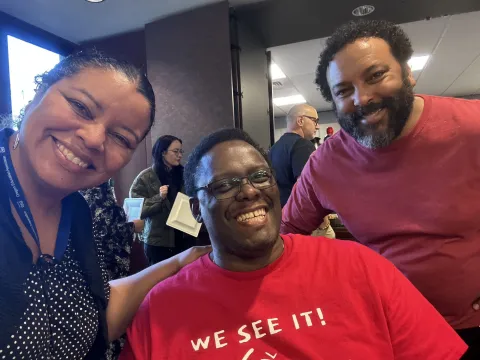
I HEAR now includes sessions for retired educators, rural members, and neurodivergent members. Weathersby envisions it continuing to expand.
“I hope I HEAR becomes the model for professional development in Oregon,” she says. “A place where educators build culturally relevant knowledge and cross-cultural friendships.”
Educators agree.
“This was the first space where some people felt safe and challenged at the same time,” Bruhn notes. “That is where transformation happens.” Many attendees build ongoing support circles after the summit.
“It strengthens our muscles for justice work,” Davenport says. “We leave ready to support our students and each other.”
Equity Is Union Work
I HEAR reflects OEA’s belief that equity is not separate from our mission. It is core to who we are.
When we learn together, we heal together.
When we heal together, we organize together.
And when we organize together, we win together.
OEA’s equity work is educator-led, community-rooted, and built for the future. And as Weathersby reminds us, this is just the beginning.